

I keep my news, investigations, and analysis free and accessible to everyone. If you value my work, your support makes it possible for me to keep doing it. Please like, comment, share, and subscribe.
Never before had so many people been taken prisoner at one time. The scale of the Allied captures at the end of World War II was unprecedented.
The Soviets took roughly 3.5 million Europeans prisoner.
The Americans took another 6.1 million.
The British about 2.4 million.
The Canadians around 300,000
The French another 200,000.
Then came the surrender of Japan in 1945. Millions of Japanese entered American captivity, while another 640,000 were taken prisoner by the Soviets.
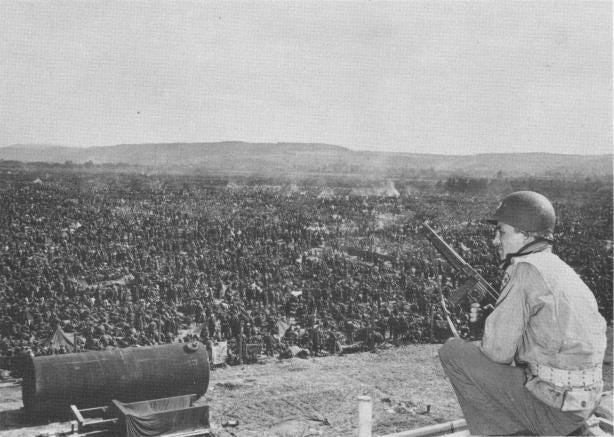
We are talking about millions of people who had surrendered their weapons and were now completely defenseless, with virtually every part of their survival controlled by the armies holding them. Whether they ate, whether they had shelter, whether they received medical treatment, whether their families ever learned where they were, whether they ever walked out of those camps alive was dictated by their captives.
And it didn’t take long for things to get ugly.
Germany surrendered on May 8, 1945. Almost immediately, General Dwight Eisenhower, then the American Military Governor, sent an urgent order throughout the territory under his command forbidding German civilians from feeding the prisoners.
It was now a crime punishable by death for German civilians to feed prisoners.
Germans weren’t even allowed to collect food with the intention of bringing it to the men in the camps. Anyone who tried to get around the blockade was warned that they could be shot.
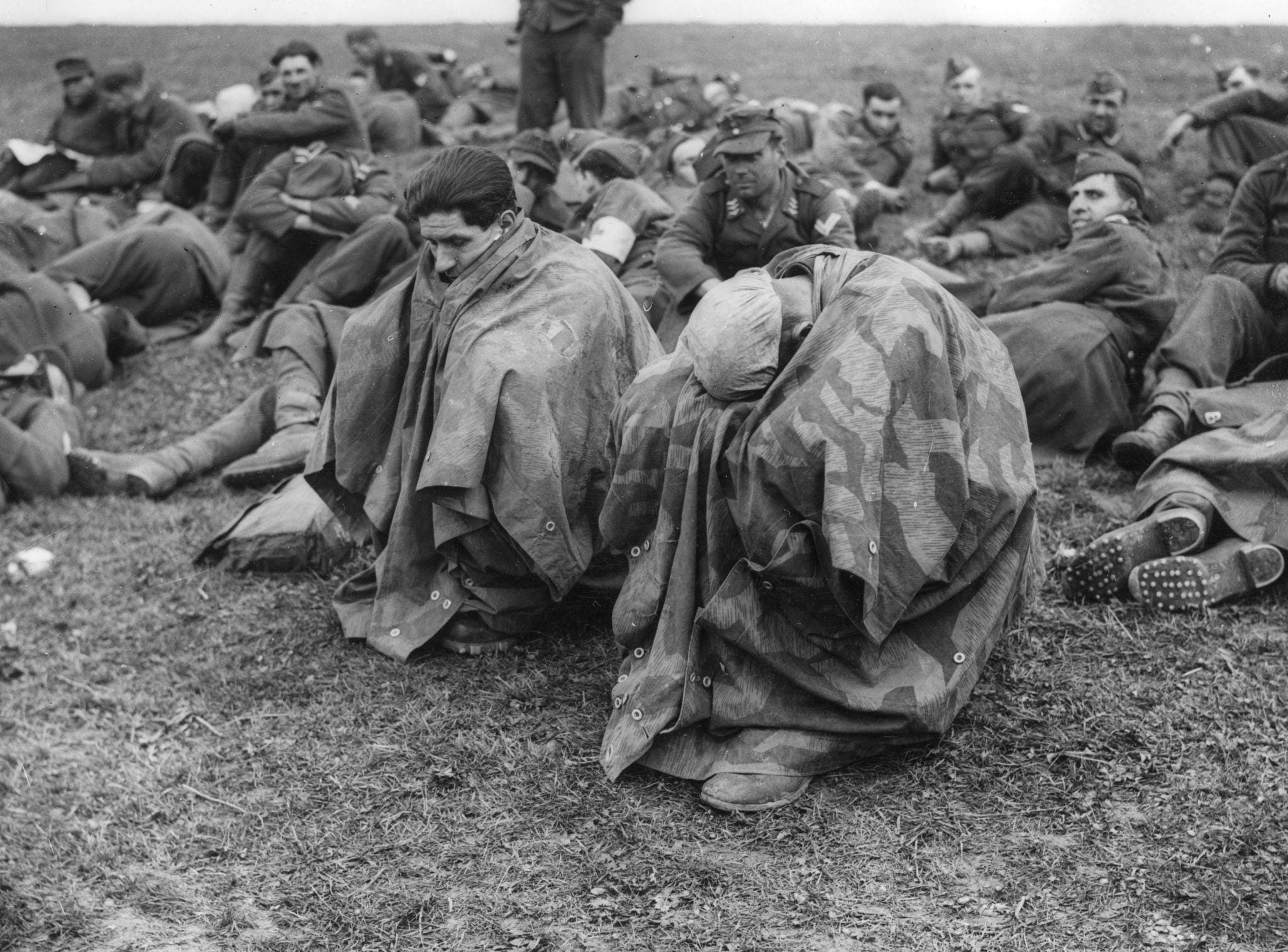
The order was written in German and sent across the American-controlled areas of Germany, with instructions to get it into the hands of local governments immediately.
Copies of the order were later found in several villages near the Rhine. And there, in writing, was the warning:
…under no circumstances may food supplies be assembled among the local inhabitants in order to deliver them to the prisoners of war.
Those who violate this command and nevertheless try to circumvent this blockade to allow something to come to the prisoners place themselves in danger of being shot…
I keep my news, investigations, and analysis free and accessible to everyone. If you value my work, your support makes it possible for me to keep doing it. Please like, comment, share, and subscribe.
The order wasn’t only circulating through local German government. It was posted on the bulletin board at the American Military Government headquarters in Bavaria, in English, German and Polish, and signed by the Chief of Staff of the Military Governor of Bavaria.
It later appeared in Polish in Straubing and Regensburg, where Polish guard companies were stationed at nearby prisoner camps.
One American Army officer who saw the order posted in May 1945 later wrote that it was:
the intention of Army command regarding the German POW camps in the US Zone from May 1945 through the end of 1947 to exterminate as many POWs as the traffic would bear without international scrutiny.
That is an American Army officer talking about something far darker than the neglect or prisoners simply dying from horrific conditions. He said the intention was to exterminate German POWs and to do so on a scale that would continue without attracting international scrutiny.
And according to American soldiers who were actually guarding these camps, starving the German prisoners wasn’t an accident. It was policy.
Martin Brech was an American soldier stationed as a guard at the Andernach camp in 1945 and later became a philosophy professor at Mercy College in New York. His first hand account of what happened at Andernach is truly horrifying. According to Brech, an officer told him directly: “It is our policy that these men not be fed.”
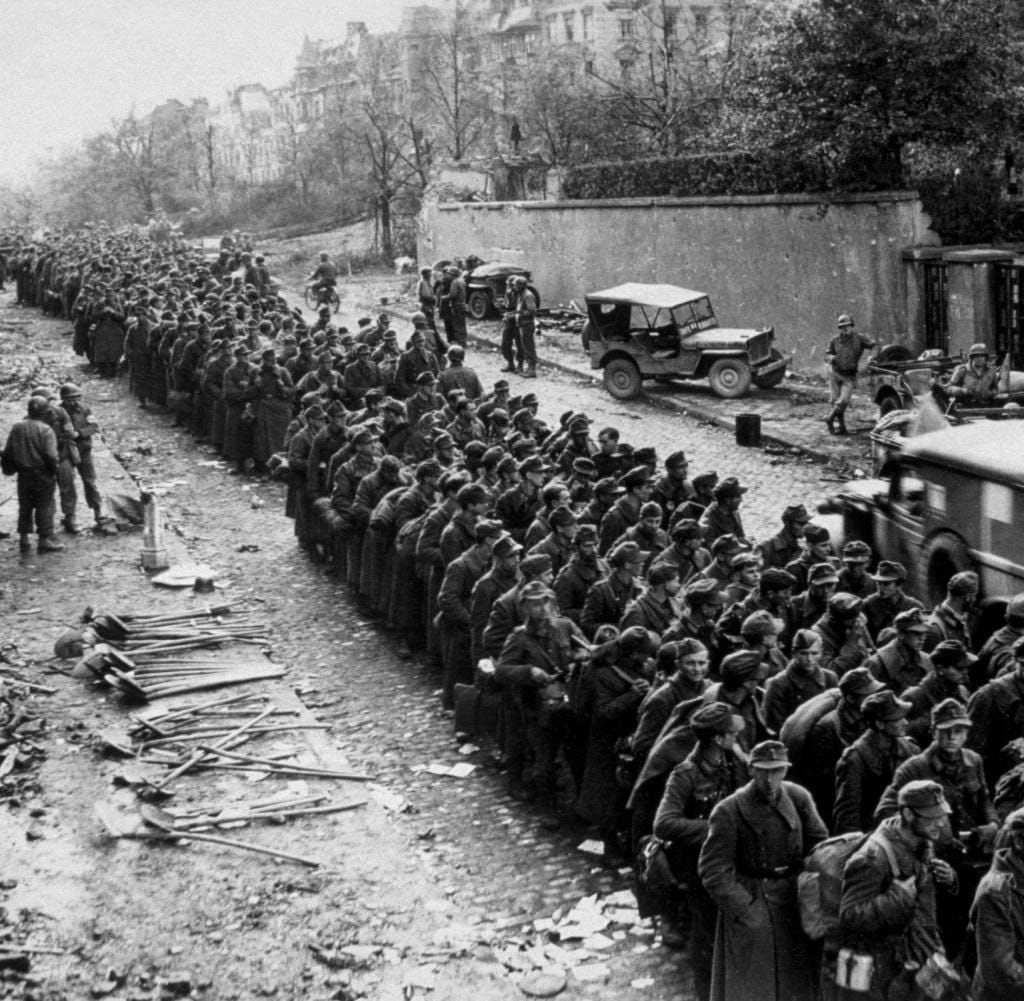
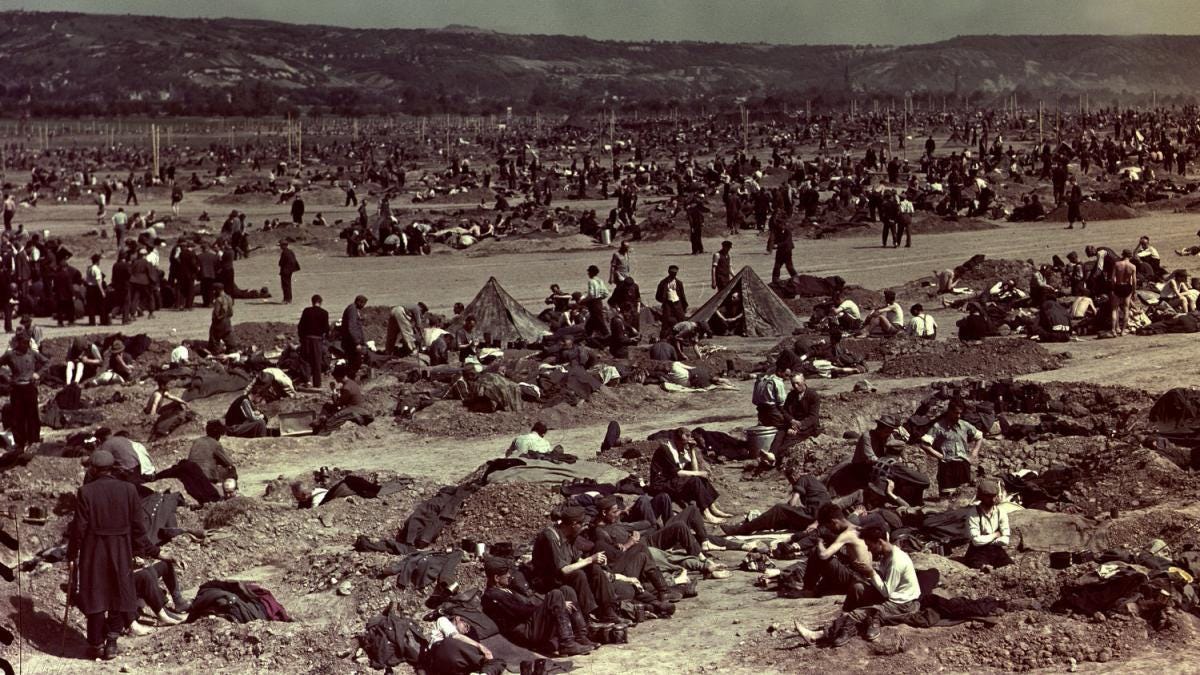
There were somewhere between 50,000 and 60,000 German prisoners packed into the camp. They had no shelter. Men were digging holes in the ground just to have somewhere to sleep, and they were so hungry they were eating grass.
Brech tried to help them.
He smuggled bread through the wire and was immediately ordered to stop by an officer.
Brech did it again anyway. He secretly brought more food to the prisoners, got caught, and this time the same officer said:
“If you do that again, you’ll be shot.”
And while these men were starving inside the camp, Brech said he watched dead bodies being hauled out “by the truckload.”
He was never told how many prisoners had died. He was never told where those bodies were buried. He was never told how they were buried.
And people were actually shot over this.
I keep my news, investigations, and analysis free and accessible to everyone. If you value my work, your support makes it possible for me to keep doing it. Please like, comment, share, and subscribe.
German prisoner Paul Schmitt was being held at the American camp at Bretzenheim when his wife and young son came to see him. They brought him a basket of food. When Schmitt walked toward the wire to see his family and get the food they had brought him, he was shot.
The French followed the same policy. In July 1945, Agnes Spira was shot by French guards at Dietersheim for bringing food to prisoners.
One of her children later wrote the words that still appear on her memorial in nearby Buedesheim:
On the 31st of July 1945, my mother was suddenly and unexpectedly torn from me because of her good deed toward the imprisoned soldiers.
And Martin Brech witnessed this kind of violence himself at Andernach. He described watching in disbelief as an American officer stood on a hillside and fired shots toward German women running away from him in the valley below.
Then there was what prisoner Hans Scharf said he witnessed at the American camp at Bad Kreuznach.
A German woman arrived at the camp with her two children carrying a bottle of wine for her husband, who was being held just on the other side of the wire. She approached an American guard and asked him to please give the bottle to her husband, who was just inside the wire.
The guard took the bottle and drank the wine himself.
He finished it, threw the empty bottle onto the ground, and then, with the man’s wife and children standing there, shot their husband and father five times and killed him.
And while prisoners inside the camps were starving, German civilians and former prisoners said they watched American guards burn the food that women were bringing to keep them alive.
One former prisoner described what he saw:
“At first, the women from the nearby town brought food into the camp. The American soldiers took everything away from the women, threw it in a heap and poured gasoline [benzine] over it and burned it.”
The prisoners were surviving on just 800 calories a day, yet food was being confiscated at the camp gates, piled on the ground, soaked in gasoline and burned right in front of them.
Karl Vogel, the German commander of Camp 8 at Garmisch-Partenkirchen who had been appointed to that position by the Americans later said the destruction of the food came on Eisenhower’s orders.
So while thousands of prisoners inside the wire were trying to survive on a fraction of the food an adult man normally needs, food brought by civilians was being deliberately destroyed outside the camp gate.
I think what bothers me most about this story is the hypocrisy of it all.
Germany had surrendered. These men were prisoners. They were unarmed, starving and completely at the mercy of the Americans holding them. And while we were telling the world that we had just defeated one of the most brutal regimes in history, American soldiers were threatening civilians with death for trying to feed prisoners. Food was being dumped on the ground, covered in gasoline and burned while starving men sat behind the wire.
How do you justify that?
We have no problem calling brutality what it is when somebody else does it. But put an American uniform on the man holding the gun and suddenly everybody wants to talk about context, excuses and why our brutality was somehow different.
I am so tired of it.
You can condemn every atrocity committed by Nazi Germany and still have the guts to look at what our own government did. Starving surrendered prisoners was disgusting. Threatening to shoot people for trying to feed them was disgusting. And after everything this government has done in wars around the world, we should be long past pretending America gets some special exemption from the same standards it demands everyone else answer to.
Relevant reading:


If you’re tired of being told everything is fine while it clearly isn’t, you’re exactly why this publication exists.
My work is 100% reader-supported. That means no advertisers, no political handlers, and no incentive to soften the truth.
I started this because too many people feel like they’re losing their minds trying to make sense of what’s happening, myself included. I wanted to build a space of like-minded people to make this journey feel less lonely for all of us.
To allow me to continue posting content just like this, please consider becoming a paid subscriber. I’m running a special for $40/year or $5/month.
If that price feels impossible to you, I understand. Share this article with everyone you know, it costs nothing but it matters more than you could possibly know.
I keep my news, investigations, and analysis free and accessible to everyone. If you value my work, your support makes it possible for me to keep doing it. Please like, comment, share, and subscribe.
Source: James Bacque, Crimes and Mercies: The Fate of German Civilians Under Allied Occupation, 1944-1950, pp. 41-45, 94-95.


