

I keep my news, investigations, and analysis free and accessible to everyone. If you value my work, your support makes it possible for me to keep doing it. Please like, comment, share, and subscribe.


The bombing of Dresden by the British Royal Air Force and United States Army Air Forces between February 13 and 15, 1945, remains one of the most horrifying Allied attacks of the Second World War, and in my view, one of the most indefensible.
What makes Dresden so horrifying is how unnecessary the destruction was, especially considering Germany had already surrendered months before. By February 1945, Germany was collapsing on both fronts and had been on a defensive retreat for two years. Dresden was not some heavily fortified military stronghold standing between the Allies and victory. It was a historic city with relatively little military infrastructure that had become packed with civilians and desperate refugees fleeing the advancing Red Army.
And then the bombers came, deliberately striking during a Christian festival.
Between October 7, 1944, and April 17, 1945, Dresden was bombed by an estimated 2,500 Allied bombers. During the devastating attacks of February 13 and 14 alone, the city was attacked by 772 British and 311 American bombers.
In four major raids, more than 1,300 British and American heavy bombers dropped 650,000 tons of high explosives and incendiaries (fire bombs) over Dresden. The high explosives ripped open buildings, tore away roofs and shattered windows before incendiaries poured into the exposed structures below, feeding fires that eventually merged into a massive firestorm across the city.


I keep my news, investigations, and analysis free and accessible to everyone. If you value my work, your support makes it possible for me to keep doing it. Please like, comment, share, and subscribe.
The word “firestorm” doesn’t begin to communicate what that meant for the human beings trapped inside it. The inferno became so intense that it created its own violent air currents, consuming oxygen and pulling air toward the flames. The fires were so fierce that people standing in the streets were sucked inside the burning buildings.
Accounts have placed the number of victims as high as 350,000, making Dresden one of the most devastated wartime atrocities of the Second World War. And I’d bet most Americans either have no idea this happened, or if they have heard of Dresden, they have no idea how utterly catastrophic it was.
WAR CRIMES
During the first wave alone, 2,640 tons of bombs were dropped on Dresden, two-thirds of them incendiary bombs designed to start fires. A massive firestorm erupted across an area eight miles square, reaching temperatures of 1,500 degrees centigrade and engulfing Dresden’s narrow medieval streets. Ninety percent of the buildings in the city center were destroyed, including more than twenty hospitals, while smoke from the burning city rose 15,000 feet into the sky.
Dresden had only minimal anti-aircraft defenses, few German troops and limited war-related industry, but the Allies still deemed it a legitimate target. Arthur “Bomber” Harris’ intention was not primarily military. He was pursuing what was called “morale bombing,” a strategy of bombing cities to demoralize the civilian population and shorten the war. Britain’s experience during the Blitz had already shown that bombing civilians typically had the opposite effect, hardening their resolve rather than breaking it.
Despite how morally and ethically indefensible this was, Allied commanders studied aerial photographs of German cities and specifically targeted areas with heavy residential populations. Harris wanted to make the “rubble bounce,” not just in Dresden, but in every German city.


The Allies knew that a bomb shelter or cellar would only protect people for about three hours before the heat became unbearable and forced civilians back outside. The second wave of bombs was therefore dropped precisely three hours after the first, again to maximize the number of casualties. Many bombs were also adapted to explode hours after they had fallen, with the intention of causing maximum casualties among civilians attempting to remove the devices.
Frankly, it sounds exactly like what the United States and Israel are doing in Gaza right now.
The bombing itself was designed to make the fires as destructive as possible. High-explosive bombs were dropped to rip the roofs from buildings, allowing incendiary bombs to fall directly into the exposed interiors, while shattered windows created the ventilation needed to feed the flames and make the fires burn even more violently.
People who survived the explosions were then dying from a lack of oxygen as the firestorm sucked the air from the atmosphere. One witness described watching people suddenly fall dead as though they had been shot, only to discover later that they had collapsed because there was no longer enough oxygen to breathe. Others jumped into a huge water tank hoping to escape the suffocating heat, only to find the water inside was boiling.
I keep my news, investigations, and analysis free and accessible to everyone. If you value my work, your support makes it possible for me to keep doing it. Please like, comment, share, and subscribe.
FATALITIES AND DESTRUCTION
Today, it’s estimated that the number of deaths are between 250,000 and 350,000. Eberhard Matthes, a lieutenant colonel and General Staff officer in Dresden at the time of the bombing, was one of the men responsible for determining the number of victims. According to his figures, 35,000 bodies were “totally identified,” another 50,000 were “partially identified,” and 168,000 could no longer be identified at all. In total, Matthes counted 253,000 dead.


During the war Dresden was a communications hub in the middle of Germany. At the time of the bombing around one million inhabitants, largely refugees, were gathered in the city. In February 1945, the city’s population had temporarily been inflated by a huge influx of German refugees. Perhaps up to 350,000 people landed in Dresden, fleeing the Soviet advance sixty miles away to the east.
With hundreds of thousands of displaced people packed into Dresden when the bombs fell, there is plenty of reason to believe that the death toll is in the hundreds of thousands.
The sheer scale of the destruction is difficult to comprehend. According to a police report prepared shortly after the bombing, 12,000 homes were destroyed, along with 24 banks, 26 insurance buildings, 31 department stores, 647 shops, two market halls, 31 large hotels, 26 public buildings, 63 administrative buildings, three theaters, 18 cinemas, 11 churches, six chapels, five cultural and historic buildings, 19 hospitals, 39 schools, five consulates, a zoo, a water facility, a railway station, 19 postal buildings, four tram buildings and 19 ships and barges.
And after all of that destruction, there was no reckoning.
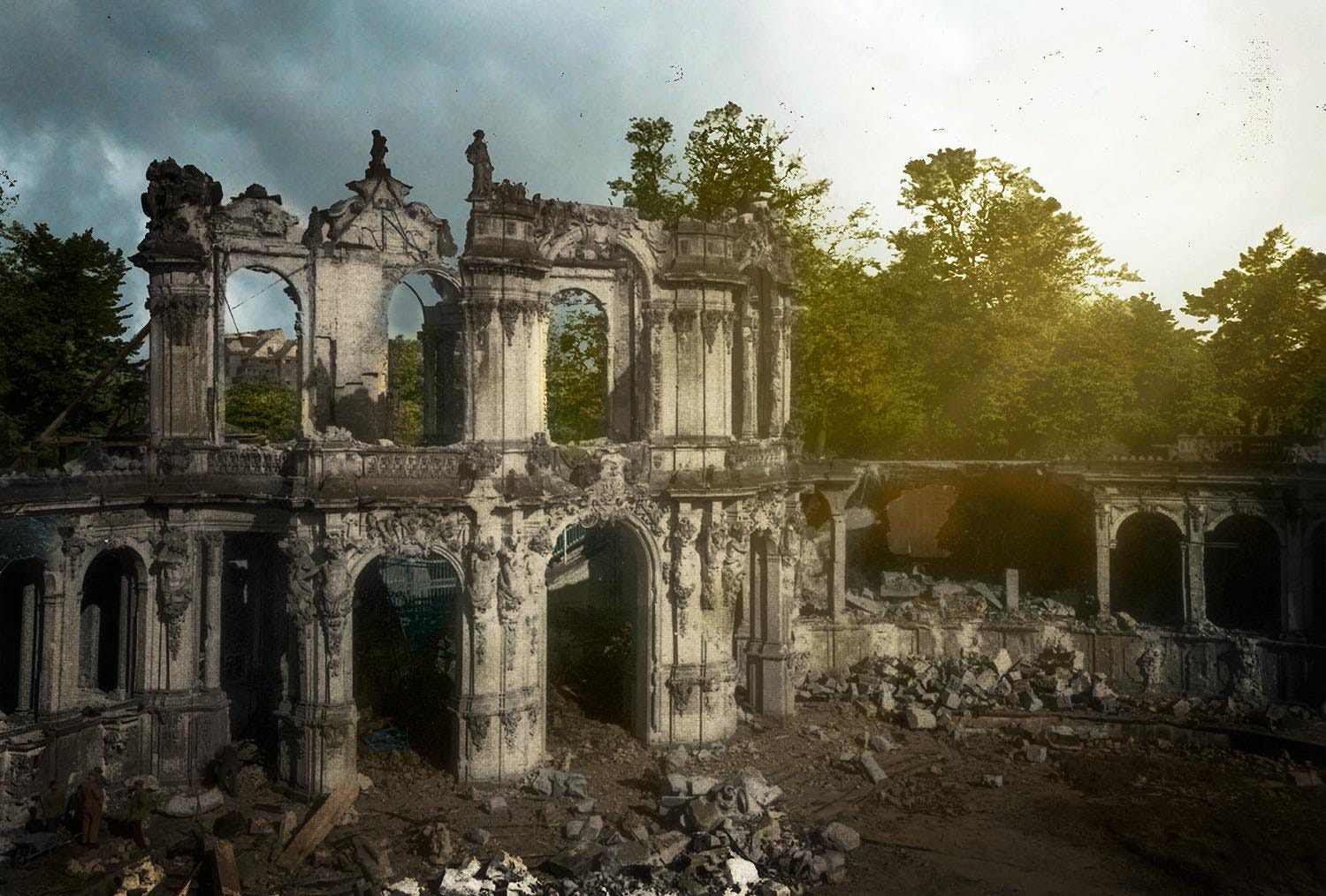
No one responsible for the bombing and destruction of Dresden was ever brought before a war crimes commission. No formal apology ever came for the civilians who were burned alive, suffocated in shelters, or died trying to escape a city engulfed in flames.
Their homes were destroyed, their families were wiped out and their city was reduced to rubble.
And eighty years later, they are still waiting for an apology that will never come.
Relevant reading:


If you’re tired of being told everything is fine while it clearly isn’t, you’re exactly why this publication exists.
My work is 100% reader-supported. That means no advertisers, no political handlers, and no incentive to soften the truth.
I started this because too many people feel like they’re losing their minds trying to make sense of what’s happening, myself included. I wanted to build a space of like-minded people to make this journey feel less lonely for all of us.
To allow me to continue posting content just like this, please consider becoming a paid subscriber. I’m running a special for $40/year or $5/month.
If that price feels impossible to you, I understand. Share this article with everyone you know, it costs nothing but it matters more than you could possibly know.
I keep my news, investigations, and analysis free and accessible to everyone. If you value my work, your support makes it possible for me to keep doing it. Please like, comment, share, and subscribe.
Shameful and disgusting and sad…
Horrible. Many people melted alive from the heat of the fire bombs. Not our finest hour.