

I keep my news, investigations, and analysis free and accessible to everyone. If you value my work, your support makes it possible for me to keep doing it. Please like, comment, share, and subscribe.
It was Shrove Tuesday, 1945, and Dresden was packed with helpless and terrified Christian refugees who had fled west with whatever they could carry as Stalin’s Red Army closed in behind them. They had poured into one of Germany’s most magnificent art cities believing Dresden might offer them some kind of refuge from a war that was swallowing everything around them.
That night, Dresden’s Lutheran and Catholic children were coming home from Mardi Gras celebrations scattered across the city. They were dressed in their festive Saxon folk costumes when they climbed aboard the train that would take them back to their families.
Within hours, Dresden would be burning.
The children were still riding the high of the night’s festivities, laughing and carrying on aboard the train before Ash Wednesday arrived on February 14 when even in the middle of a war their families would observe the solemn Christian remembrance of the passion and death of Jesus.
Then Allied fighter planes appeared overhead.
They spotted the civilian train below and opened fire.
Bullets ripped through the carriages packed with children. Glass shattered, metal tore apart, and blood poured from the wreckage. What had been a train full of laughing children only moments earlier had become a scene of carnage.
And yet this carnage barely registers in the American mind.
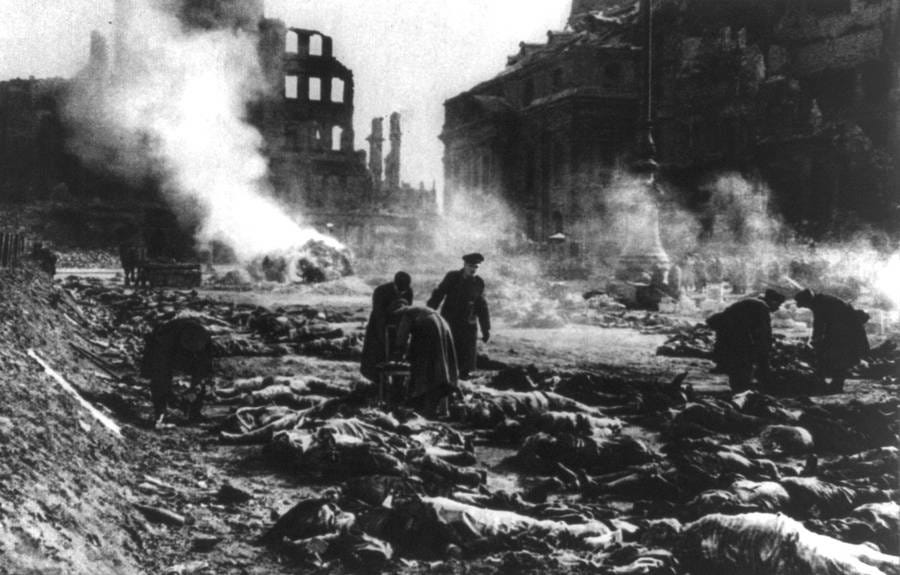
The holocaust of Dresden lasted two days and killed at least 100,000 civilians, yet like the atomic destruction of Hiroshima and Nagasaki, it is usually given little more than a few sentences or a paragraph buried in the back of a history book.
I keep my news, investigations, and analysis free and accessible to everyone. If you value my work, your support makes it possible for me to keep doing it. Please like, comment, share, and subscribe.
Now compare that with Holocaust Remembrance Day every April. There are ceremonies, school programs, political speeches and wall-to-wall media coverage, with everyone from the Vatican to the White House expected to publicly remember, mourn and apologize.
So where is that same ritual of remembrance for the German civilians burned alive in Dresden? Where is it for the Japanese civilians incinerated at Hiroshima and Nagasaki?
Their dead receive nothing approaching the same cultural attention. Their suffering has never been given the same sacred place in our collective memory, and after eighty years, we should be willing to ask why. Why are some civilian victims remembered constantly, generation after generation, while others have been reduced to a paragraph in the back of a history book, if they are discussed at all?
The barely remembered German and Japanese victims of Allied war crimes were of the wrong race and religion.
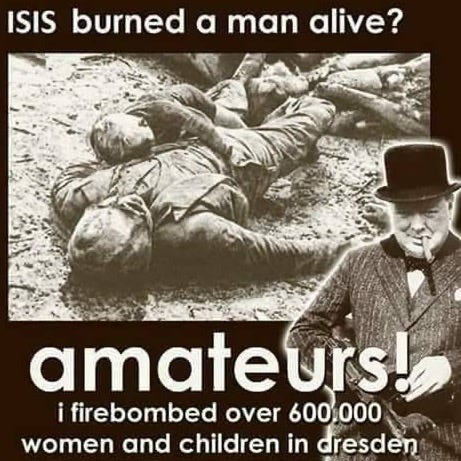
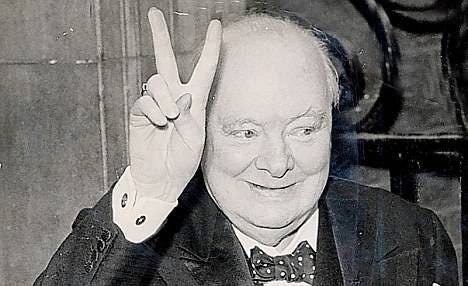
By the spring of 1945, after executing the bombing holocaust unleashed against virtually every major German city, Winston Churchill could see the end of the Second World War approaching in Europe. He could also see what might follow. The estimated 500,000 German civilians incinerated under a bombing campaign he had championed could come back to haunt him and permanently stain the reputation he would carry into the postwar world.
So on March 28, 1945, Churchill issued a deceitful, back-stabbing memo attempting to shift the blame for the mass incineration of German civilians onto his own Bomber Command and, by insinuation, its commander Arthur Harris. The very airmen who had carried out Churchill’s orders would be denied a postwar campaign medal, while Harris himself was denied the prestigious title and national recognition normally bestowed on Britain’s senior wartime commanders by the British Crown.
Harris and Bomber Command had only been following Winston Churchill’s explicit orders, yet when the bloodshed threatened to stain his own legacy, Churchill attempted to shift responsibility onto the very corps of airmen who had carried out those orders and suffered some of the highest casualty rates of any branch of the British military.
Churchill, like many others, endeavored to blame Germany for being the first to terror-bomb civilians, pointing to Guernica and Rotterdam and claimed that thousands had been killed. Even one death is regrettable of course, but less than 100 people were killed in Guernica and less than a thousand in Rotterdam.
The Germans had pledged not to be the first to bomb civilian centers in Britain and almost a year after Britain declared war, Germany still had not dropped a single bomb on London. Churchill, however, had hoped they would carpet-bomb the city, giving him the excuse he needed to silence the large peace movement in England that had been dogging him throughout 1940.
That changed toward the end of August 1940, when a German bomber reportedly lost its way while flying up the Thames. Its orders were to attack an oil refinery, but it mistakenly dropped its bombs on London’s East End. Thankfully, no one was killed, but Churchill finally had the excuse he needed to massively retaliate against Berlin.
I keep my news, investigations, and analysis free and accessible to everyone. If you value my work, your support makes it possible for me to keep doing it. Please like, comment, share, and subscribe.
He ordered roughly a hundred RAF bombers to attack the German capital despite warnings from his own commanders that the Luftwaffe would retaliate against London. Hitler responded in kind, the Blitz followed, and the British peace movement that had been dogging Churchill disappeared amid the smoke and flames.
At this juncture we pause to contemplate the bloody treason that was at the heart of Churchill’s soul: he wanted as many of his own English civilians in London to die as possible so he could point to their deaths as the justification for a total war against Germany; and he succeeded in his objective.
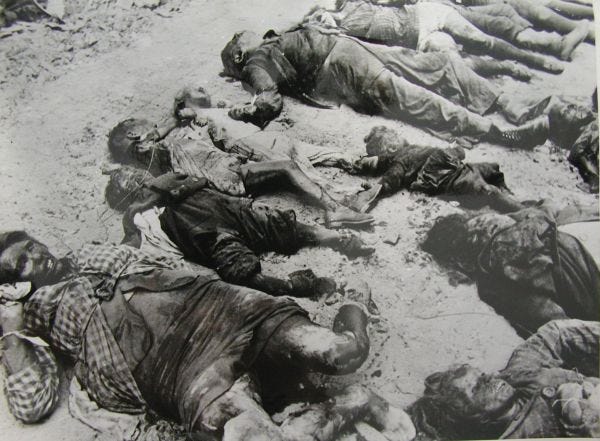
More than eighty years later, we are still being handed the same excuse for what Britain and the United States did to Dresden: Germany did it first. Germany bombed Guernica. Germany bombed Rotterdam. Look what Germany did to London.
Nothing that occurred in Guernica, Rotterdam, or for that matter London, begins to even approach the scale of the holocaust that the firebombs of Churchill’s and Franklin Roosevelt’s militaries inflicted on Dresden.
You won’t find any of these facts in Churchill’s own sprawling history of the war and you certainly won’t find any mainstream historians eager to linger on them. If you want the other side of this history, you have to be willing to read the revisionists, especially the ones the media demonizes.
And if you’re wondering where to even start, that’s exactly why I put together my Forbidden Reading List. You can find it here.
Many mainstream historians have no problem denying the holocaust casualty figure of 100,000 for Dresden, but God help any one of us who have the guts to doubt the Six Million casualty figure of the “Holocaust,” or even dares to use the word “holocaust” to describe what happened in Dresden.
I challenge any reader to go through legacy media coverage of the bombing of Dresden from the 1990s onward and count how many times they actually use the word “holocaust” to describe what happened there.
The extent to which we have imprisoned ourselves in an Orwellian dystopia becomes painfully obvious when you consider that simply violating the self-appointed Newspeak trademark surrounding the word “holocaust” can be treated as deeply insensitive or even “antisemitic.” Dare to apply that same word to the German cities that were incinerated or to Hiroshima and Nagasaki, and watch how quickly people tell you that you’re not allowed to use it.
Except those war crimes were genuine holocausts by the literal dictionary definition of the word: “destruction or slaughter on a mass scale, especially caused by fire.”
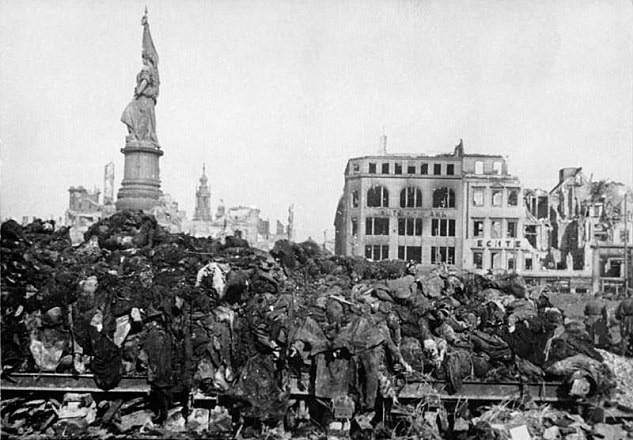
A half-million German civilians and three-quarters of a million Japanese civilians (including the victims of the fire-bombing of Tokyo) were indeed burned to death, yet it is a thought crime to say so. Tell me we are not all cowards for allowing truth itself to be forbidden.
You cannot claim ownership over a word and then demand that everyone ignore its actual definition when it is applied to victims you would rather not talk about.
There are mainstream historians who have built entire careers around stigmatizing anyone who dares question any part of the accepted Holocaust narrative, immediately branding them a “Holocaust denier.” Yet those same historians are perfectly free to deny that what happened in Dresden was a holocaust, with virtually no professional or social consequences whatsoever. They may do as they like with history in ways that the rest of us may not.
Relevant reading:


If you’re tired of being told everything is fine while it clearly isn’t, you’re exactly why this publication exists.
My work is 100% reader-supported. That means no advertisers, no political handlers, and no incentive to soften the truth.
I started this because too many people feel like they’re losing their minds trying to make sense of what’s happening, myself included. I wanted to build a space of like-minded people to make this journey feel less lonely for all of us.
To allow me to continue posting content just like this, please consider becoming a paid subscriber. I’m running a special for $40/year or $5/month.
If that price feels impossible to you, I understand. Share this article with everyone you know, it costs nothing but it matters more than you could possibly know.
I keep my news, investigations, and analysis free and accessible to everyone. If you value my work, your support makes it possible for me to keep doing it. Please like, comment, share, and subscribe.
This article was informed by the reporting and research of Michael Hoffman in The People Who Were Burned to Ashes on Ash Wednesday. Portions of their reporting have been cited directly, paraphrased and incorporated alongside my own research, analysis, commentary, and additional sources. I encourage readers to read the original article here.
Thank you for covering this. Completely agree that it is barely known about let alone discussed in the West. I became aware through reading Slaughterhouse 5. I mention it to family and friends and get the what aboutisms. Kind of like when you bomb a school full of innocent girls. As my college history professor used to say, everyone wants to sleep well at night.
My father was from Germany. His maternal grandparents, Aunts, Uncles, cousins, young girls, were from Dresden. All killed on those 2 nights. I read about in detail fairly recently. The Allies did that double tap we hear about in Gaza where the area is attacked again when the rescue people get bombed too. Certain people have that saying, 'we must never forget'. If you ask a German, like my mother, who fled from the Russians, lost her home, separated from parents, starving, dodging low flying planes firing at civilians like her whilst out looking for food, she'd tell you "yes, it was so horrible, that time, not knowing who was alive, where we could get food, if we'd have a roof over our heads, if we'd be shot by partisans, the Dutch red neckerchief wearing men who could spring up and shoot at anyone, anytime, I want to forget, it's too painful to remember". She was 81 when she told me that when my father was dying and I realised I knew nothing much about their early lives and war time experiences. We both shed lots of tears as she recounted those years.