

This content is information the American ruling elite do NOT want you to have access to. If you appreciate work like this, and want more of it, please consider becoming a paid subscriber.
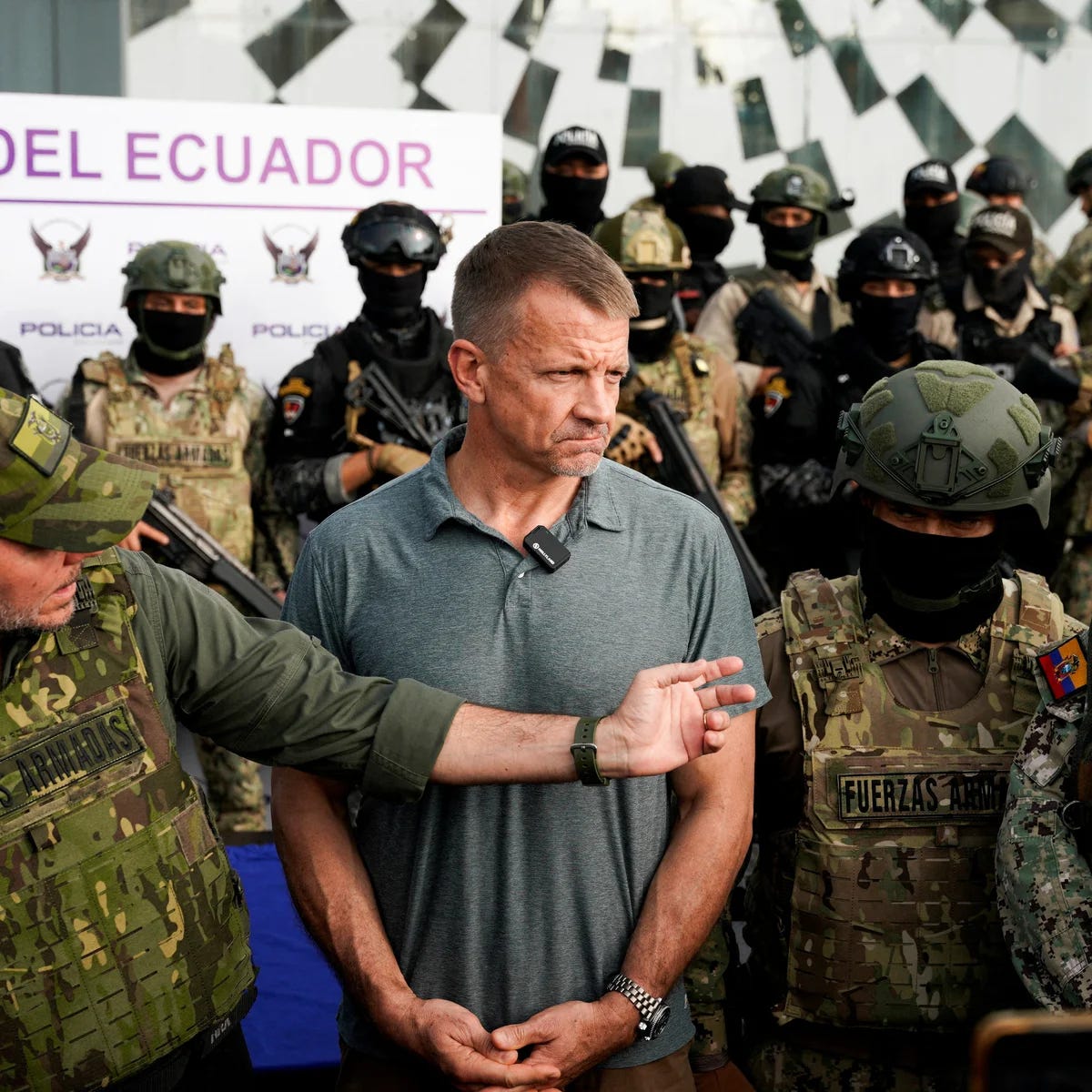
Erik Prince is the modern architect of private military firms. He’s the brain behind the infamous private military firm Blackwater and his current venture is mass killing civilians in Haiti with drones. The latest reporting is that he’s killed over 1,200 people, including children.
But he's been all over the world, building a global pipeline of mercenaries, recruiting everyone from American veterans to people in poorer countries who are willing to fight for a fraction of the price.
Prince is partially responsible for modernizing the private army for the post 9/11 world. The U.S. government loves plausible deniability, and that’s where private mercenaries come into play. When the U.S. isn’t supposed to be in a certain country, they can “truthfully” say they’re not operating there, because technically, they’re not. A mercenary is.
And the cherry on top—well for the U.S., certainly not the civilians in the countries they’re operating—is that these companies are able to skirt traditional regulations that are meant to ensure accountability for the U.S. Armed Forces. These mercenaries don’t have something like a Uniform Code of Military Justice or the Geneva Convention to follow. They are brutal. And they are deadly.
His journey from hiring mercenaries to help bolster the U.S. occupation in Iraq to training China’s military is long and dizzying. It also included stops around the world to train Colombian mercenaries to help make a private army for the U.A.E., to outfitting crop duster planes with missiles to be fired at Armenians.
Below is a partial breakdown to track Erik Prince’s activities over the years, with a list of countries/regions in or for which he has done business.
United States
Prince’s trip around the world starts in the United States.
The child of affluent Michigan parents, his family maintained deep ties to the Republican establishment and several conservative, religious organizations like American Values.
His sister, Betsy DeVos, married into one of the most influence political families in the Midwest, the DeVos’s, and began helping to run the Republican party machine in Michigan.
That marriage, which tied the Prince and DeVos family together, has given Erik unprecedented political access into the federal government.
His list of close allies includes Steve Bannon, U.S. President Donald Trump’s former chief strategist and Jeffrey Epstein’s good friend. His sister served as the United States Secretary of Education from 2017 to 2021, giving him a direct line of access to Trump.
Erik became a Navy SEAL and then established his own private military firm in 1997, Blackwater.
Once the U.S. invaded Iraq in 2003, Blackwater received billions of dollars in contracts from the U.S. government to help supplement the official mission with private boots on the ground, relatively free from accountability or laws from any particular government.
Iraq

Blackwater’s activities in Iraq are infamous and account for Prince’s self-imposed exile from the United States.
Apart from harassing Iraqi civilians and running them off of roads with their armored personnel carriers, they also indiscriminately gunned down 14 innocent people in Baghdad in 2007, drawing an investigation and heavy criticism from media outlets around the world.
The incident stands as a cautionary tale for when mercenary groups such as Blackwater are able to operate without sufficient legal or logistical oversight.
Facing a wave of scrutiny, Prince left Blackwater and the firm changed its name twice (to Xe and then Academi) to escape the heat.
Many thought, and hoped, that they had seen the end of Erik Prince, but he resurfaced later at the helm of a different private military company.
In 2020, Donald Trump pardoned all 4 people who were convicted of murdering these innocent Iraqi civilians.
This content is information the American ruling elite do NOT want you to have access to. If you appreciate work like this, and want more of it, please consider becoming a paid subscriber.
U.A.E.
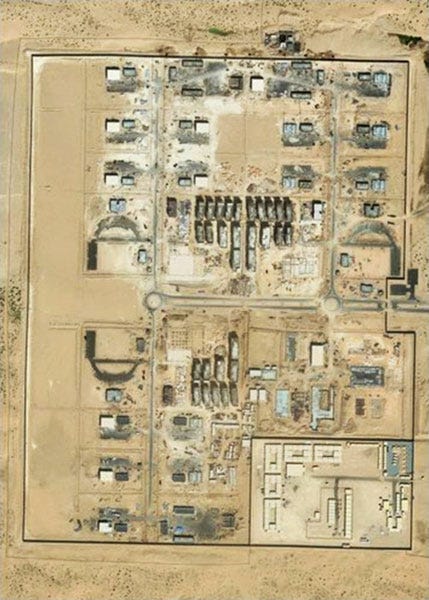
In 2011, Erik Prince was appointed by the crown prince of Abu Dhabi to make a secret, private army. For this, he was paid $529 million.
The mission of this privately commissioned battalion included,
“intelligence gathering, urban combat, the securing of nuclear and radioactive materials, humanitarian missions and special operations ‘to destroy enemy personnel and equipment,’ and crowd-control.”
Prince hired Colombians and nationals of other countries thousands of miles away to fill his ranks for two reasons.
First, Prince was looking to pay them as little as possible. Second, they weren’t Muslims. Prince surmised that Muslims could not be trusted to kill other Muslims.
A few years later in 2015, Saudi Arabia began its military intervention in Yemen and recruited a host of other Arab nations to join its coalition.
Abu Dhabi’s crown prince, business partner to Erik Prince, Sheik Mohamed bin Zayed al-Nahyan, signed up for the cause in order to destroy any creeping Iranian influence in the war-torn nation.
Yemen
Erik Prince and his U.A.E. private military firm helped recruit and train over 1,000 soldiers from Latin American countries. Then their bodies started appearing on battlefields in Yemen.
A single missile reportedly killed 45 mercenaries from the U.A.E.
Prince's initial battalion of 800 soldiers had blossomed into almost 2,000 specialized troops hired mostly from Latin America to do the U.A.E.'s business.
Although officials say Erik Prince's formal business role with the U.A.E. had ended several years before the intervention into Yemen, his corporate blueprint to partially outsource the U.A.E.'s military is doubtlessly still in use.
The U.A.E. keeping and even expanding Prince's blueprint for a private, outsourced army demonstrates just how influential he and his mercenary business model has become.
Azerbaijan

After his stint in the U.A.E., Prince began doing more business with Chinese executives at the Frontier Services Group (FSG), which he co-founded.
On this new enterprise, Prince said it,
“is not a patriotic endeavor,” rather, it is intended “to build a great business and make some money doing it.”
Interestingly enough, Prince’s business with FSG took him to Azerbaijan, where he was paid by the government to help it deal with its Armenian problem.
Armenians are concentrated into Azerbaijan’s Nagorno-Karabakh region, which seceded from Azerbaijan and formed a semi-recognized, de facto state.
Azerbaijan called on Erik Prince and FSG to help it keep watch on the Nagorno-Karabakh region, also called the Republic of Artsakh.
In response, Prince wanted to show the government two crop duster planes meant for agricultural use but refitted for military purposes. The planes were meant to be outfitted with state-of-the-art surveillance technology and were supposedly able to fire missiles.
They never made it to Azerbaijan after an investigation shut the sale down. This is because the deal may have broken several laws.
The Washington Post found that,
“executives were concerned that the company might be skirting U.S. law - known as International Traffic in Arms Regulations (ITAR) - requiring Americans to obtain special permits before defense-related technology can be transferred to foreign countries.”
In response to this controversial arms trade, all but two Americans on the FSG executive board quit due to concerns that he was not serving U.S. interests.
This has freed Prince to deal more closely with the Chinese.
This content is information the American ruling elite do NOT want you to have access to. If you appreciate work like this, and want more of it, please consider becoming a paid subscriber.
Eastern Africa
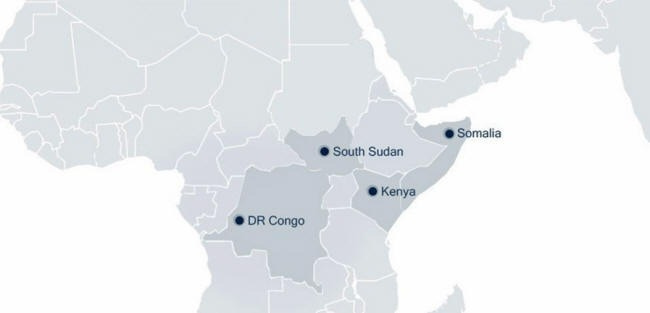
FSG’s public focus is on providing security and logistical “help” to eastern African countries such as South Sudan, Kenya, Somalia and the DRC.
“When you want logistics done in Africa, you call DHL,” said Sean McFate, a former military contractor in Africa and current expert on mercenaries at the Atlantic Council.
“When you want muscle, you call Erik Prince.”
South Sudan, Somalia and the DRC are among the most exploited and poorest countries in the world, so I don’t think the civilians in either of these countries would say FSG helped them much at all.
China
FSG’s headquarters is in Hong Kong, and though it publicly states that its focus is on eastern Africa, FSG was reported to be doing domestic work on behalf of the Chinese government.
One of FSG’s missions was to train thousands of security personnel in China’s northwest Xinjiang province, where millions of ethnically Turkic Muslims called Uyghurs live.
Uyghurs are routinely targeted by the state due to continuous attempts by some to break away from China and form an independent state.
Human Rights Watch accused the Chinese government of “deploying a predictive policing program,” using massive surveillance technology and a web of high-tech surveillance cameras and compulsory data collection.
They’ve also reportedly sent thousands of Uyghurs to Chinese ‘re-education’ camps.
To Recap:
Erik Prince co-founded a security company alongside Chinese state investors, during Trump’s first term. He held top executive control and served as the public face, and they operated in Africa, Asia and inside of China, while at the same time, his sister was serving inside of Trump’s administration.
…got it. The whole “rules for thee but not for me” thing. Okay.
Mercenary-In-Chief
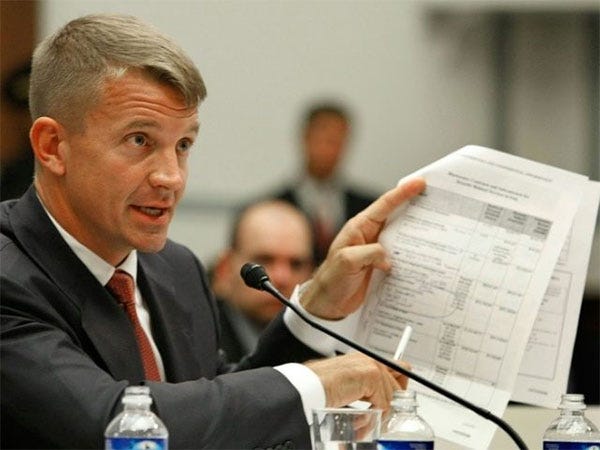
This list only details a few of Erik Prince’s ventures, and does not include an attempt by Prince to send thousands of mercenaries into Afghanistan to “reform” the political structure of the entire country to essentially be a colony of the United States.
Thanks to Erik Prince, outsourcing military and intelligence labor is now the norm.
The global private security industry is worth around $277 billion and is projected to reach over $530 billion by the early 2030s. In the United States alone, the industry is worth around $49 billion.
Governments all around the world use these companies to exploit poorer countries, and to rape, murder and pillage their people, and they are very rarely held accountable for anything that they do.
Their motivation is not God and country, their motive is money.
Imagine how demonic one must be to profit from war, death, destruction and chaos. Making billions of dollars off of human suffering, millions of whom are children. Their evil truly knows no bounds.
If you’re tired of being told everything is fine while it clearly isn’t, you’re exactly why this publication exists.
My work is 100% reader-supported. That means no advertisers, no political handlers, and no incentive to soften the truth.
I started this because too many people feel like they’re losing their minds trying to make sense of what’s happening, myself included. I wanted to build a space of like-minded people to make this journey feel less lonely for all of us.
To allow me to continue posting content just like this, please consider becoming a paid subscriber. I’m running a special for $40/year or $5/month.
If that price feels impossible to you, I understand. Share this article with everyone you know, it costs nothing but it matters more than you could possibly know.
This content is information the American ruling elite do NOT want you to have access to. If you appreciate work like this, and want more of it, please consider becoming a paid subscriber.
Thank you for all of your work.
This is an incredible report… who would’ve thought Betsy DuVois… White Karen was in bed with such monstrous killers… a brother…