

I keep my news, investigations, and analysis free and accessible to everyone. If you value my work, your support makes it possible for me to keep doing it. Please like, comment, share, and subscribe.
The United States government just invaded Venezuela under the guise of ‘fighting the drug war’.
Now, that’s confusing, considering the U.S. government, CIA, and DEA singlehandedly CREATED the global drug problem. Stay tuned for a future post where I’ll go into detail on this.
So, I figured now is as good a time as any to remind everyone that over 80 foreign governments have been overthrown or destabilized by the United States, and no, most of them were NOT dictatorships, but democratically elected governments.
The playbook is almost always the same:
A country elects a leader who wants to use their land, oil, or industry for the people, which threatens the profits of the United States
The CIA steps in and begins funding opposition groups (ISIS, Al-Qaeda, etc), planting stories in the media (Assad is gassing his own people! and Venezuela is guilty of drug trafficking to the U.S!), as well as bribing generals, arming rebels, or even collapsing their economy
The coup replaces the current leader with a pro U.S. dictator military regime
Hundreds of thousands (or even millions) of people die during the conflict
Even more people die after the military dictator is installed, typically as a result of torture, considering most of the countries’ civilians oppose this new leader
It is NEVER about ‘democracy’ or ‘human rights’, or ‘fighting drugs’, but it’s ALWAYS about power, profit, and control.
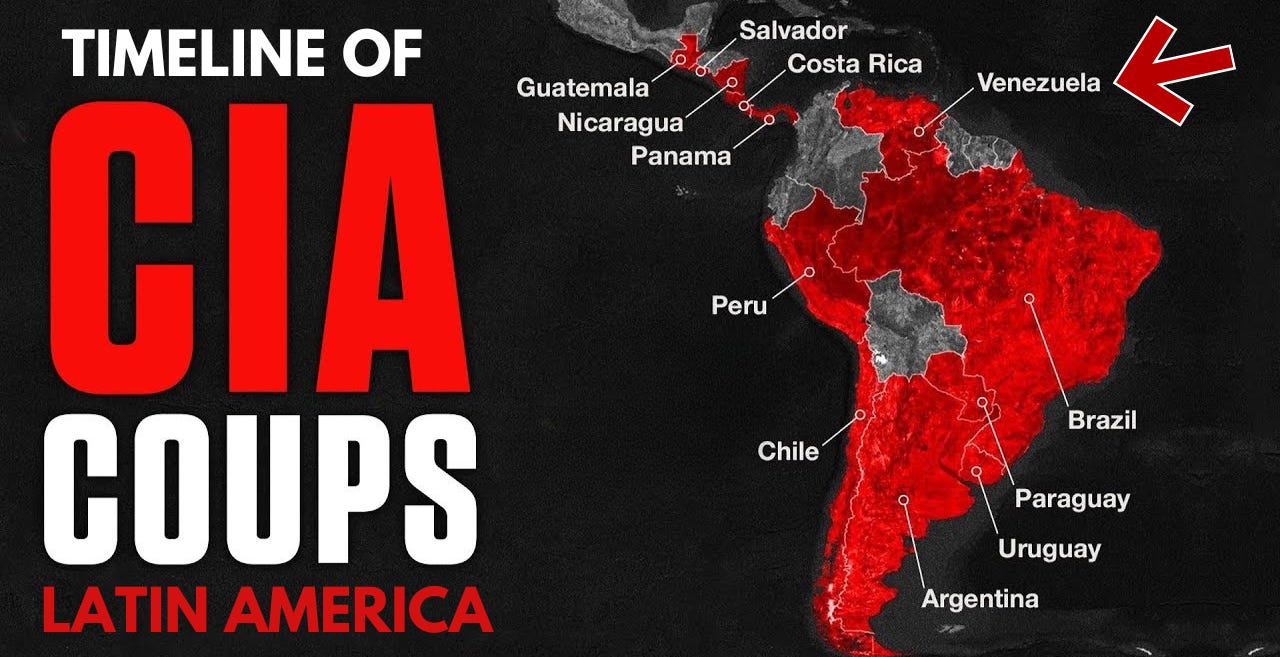
Considering this current coup is taking place in Latin America, I wanted to build a timeline that showcases all of the coups that the U.S. government has been involved in inside of Latin America.
Please share this with a friend to help spread the truth about the current heinous acts of the U.S. government.
I keep my news, investigations, and analysis free and accessible to everyone. If you value my work, your support makes it possible for me to keep doing it. Please like, comment, share, and subscribe.
A TIMELINE OF CIA OPERATIONS IN LATIN AMERICA
1950: Guatemala
President Arbenz sought to nationalize the United Fruit Company, an American multinational corporation. With this nationalization, Arbenz was giving land back to his own people, which would result in the UFC losing its monopoly on this land and their profits. Due to this, the UFC lobbied the U.S. government to overthrow Arbenz. The CIA framed Arbenz as a communist threat, leading to the covert operation PBSuccess that installed a U.S.-friendly military dictatorship which sparked decades of conflict.
This plunged Guatemala into a civil war from 1960-1996, which resulted in the deaths of 200,000 citizens.
1954: Paraguay
The U.S. claimed Paraguay was at risk of communism. In reality, the country was taken over because Washington wanted a permanent intelligence outpost in the heart of South America. The leader installed in the 1954 coup, Alfredo Stroessner, was willing to rule through terror to provide it. His dictatorship lasted from 1954 to 1989, one of the longest in Latin American history. Over 100,000 people were imprisoned, and tens of thousands were tortured under his rule.
1958: Panama
Panamanian students and workers protested U.S. control of the Panama Canal and Canal Zone, demanding greater sovereignty. The United States responded with military force, deploying troops to suppress unrest and protect U.S. interests. Several Panamanians were killed and dozens injured. While no government was overthrown, the intervention reinforced U.S. dominance over the canal and established a precedent for direct military involvement in Panama’s internal affairs.
1960: Cuba
The CIA devised a plan to train Cuban exiles to invade the country and overthrow Fidel Castro. Castro found out about the training camps through Cuban intelligence. In 1961, President John F. Kennedy signed off on the Bay of Pigs Invasion, a plan for the Cuban exiles to overthrow CAstro. The invasion ultimately failed when the Cuban military overwhelmed them.
1961: Brazil
President Goulart raised corporate taxes–which happens to fall under the definition of ‘communism’, according to the U.S. government. So the CIA spread anti-communist propaganda, funded pro-US politicians, and claimed Goulart was a ‘threat to democracy’. This resulted in a military coup which established a US-friendly dictatorship that would last until 1985. 20,000+ people were tortured throughout this dictatorship, at the hands of the U.S. government.
1963: Ecuador
After going through 27 presidents between 1925 and 1947, Ecuador witnessed a rare period of stability in the 1950s. Unfortunately, this was not to last. President Arosemena Monroy pursued an independent foreign policy from Washington, and refused to break ties with Cuba. The CIA stepped in, financed the spread of anti-communist propaganda, and staged a military coup against him.
A CIA agent is quoted saying, “In the end, they [the CIA] owned almost everybody who was anybody [in Ecuador].”
The CIA installed government severed ties with Cuba, aligning with U.S. interests.
1964: Bolivia
President Estenssoro tolerated powerful labor unions and allowed miners and peasants to retain political influence, which under U.S. logic, qualified as a ‘communist threat’. In response, the CIA funneled aid and training to Bolivian security forces, and framed the government as unstable and vulnerable to communism. This resulted in a military coup that installed a U.S.-aligned dictatorship under René Barrientos. His regime carried out systematic repression against civilians, killing hundreds and imprisoning and torturing thousands, with full U.S. support. In 1967, Bolivian forces, assisted by the CIA, captured and executed Che Guevara in Bolivia, who had helped overthrow a U.S.-backed dictatorship in Cuba, with Fidel Castro.
They performed a second coup in Bolivia in 1971.
1965: Dominican Republic
President Bosch was democratically elected but pursued mild social reforms and refused full alignment with U.S. Cold War priorities, which Washington treated as a communist risk. When a popular uprising sought to restore him to power after an earlier military overthrow, the United States intervened militarily, with 42,000 U.S. troops, framing the movement as a communist threat. This resulted in a U.S. occupation and the installation of a compliant, U.S.-backed government under Joaquín Balaguer. The regime that followed relied on repression, political violence, and security force killings to suppress opposition, leaving thousands dead over the subsequent years and cementing long-term U.S. influence.
1970: Uruguay
Rising labor unrest and leftist movements were treated as a communist threat, so the Central Intelligence Agency and U.S. security agencies provided counterinsurgency training, intelligence support, and policing assistance to Uruguayan forces. This escalated repression and normalized torture as a tool of governance. The process culminated in a military coup that installed a U.S.-aligned dictatorship. Over the following years, thousands were imprisoned and tortured, hundreds were killed or disappeared, and Uruguay became one of the most heavily repressive states in Latin America.
1973: Chile
Democratically elected President Allende was overthrown in a U.S-backed military coup and replaced with one of the most notorious dictators of all time (Pinochet), who committed horrific atrocities; with the full backing of the United States.
President Allende shot himself dead using an AK-47 rifle before he was captured.
Pinochet ruled with an iron first for 17 years, where he tortured and killed thousands of civilians. Why did the U.S. government do this? Because President Allende wanted to nationalize copper and improve labor conditions in his country, which threatened U.S. corporate profits.
1975: Six Latin American countries AKA Operation Condor
Leftist parties, labor movements, students, and dissidents across South America were labeled a communist threat, which, under U.S. Cold War doctrine, justified elimination. In response, the CIA coordinated intelligence sharing, training, and logistical support among the military regimes of Chile, Argentina, Uruguay, Paraguay, Bolivia, and Brazil under Operation Condor. The operation was aimed at crushing political dissidents. The dictatorships used a shared database to monitor dissidents and their families across state borders.
This created a transnational system of state terror that allowed governments to kidnap, torture, disappear, and assassinate opponents across borders. The campaign resulted in tens of thousands killed or disappeared and hundreds of thousands imprisoned and tortured, with full U.S. awareness and support.
I keep my news, investigations, and analysis free and accessible to everyone. If you value my work, your support makes it possible for me to keep doing it. Please like, comment, share, and subscribe.
1976: Argentina
Labor movements and leftist politics were framed as a communist threat by the U.S. government. In response, the CIA supported a military coup that overthrew the government and installed a U.S.-aligned dictatorship under Jorge Rafael Videla. What followed was the Dirty War: a systematic campaign of state terror involving secret detention centers, torture, and enforced disappearances. An estimated 30,000 people were killed or disappeared, and tens of thousands more were tortured or imprisoned, with Argentina fully integrated into Operation Condor and operating with U.S. knowledge and cooperation.
1981: El Salvador
In December 1981, the Salvadoran military’s elite Atlacatl Battalion conducted a deadly massacre in the village of El Mozote, killing about 1,000 people, who were overwhelmingly women, children, and elderly civilians. This battalion was trained and equipped by the United States Government / CIA. The U.S. greatly increased military aid to El Salvador between 1980 and 1982.
This backing enabled the U.S.-aligned government to wage a brutal civil war marked by death squads, massacres, and systematic terror against civilians. Over the course of the conflict, more than 75,000 people were killed, thousands disappeared, and tens of thousands were tortured, with U.S. officials fully aware of widespread atrocities.
1982: Honduras
‘Anti-communism’ was used to justify turning Honduras into a U.S. counterinsurgency hub. The CIA and the U.S. government massively expanded military aid, intelligence operations, and training for the Honduran government. This backing enabled Honduran security forces to carry out a campaign of enforced disappearances, torture, and extrajudicial killings, most infamously through Battalion 316. During the 1980s, hundreds of people were disappeared or killed, thousands were detained and tortured, and Honduras was transformed into a U.S. military and intelligence hub for regional wars, including operations against Nicaragua and El Salvador.
1983: Grenada
Grenada pursued an independent path from Washington, and aligned itself with Cuba, which the U.S. government framed as a communist threat to regional security. The United States intervened militarily, sending over 9,000 troops (19 of whom were killed), under the guise of protecting U.S. citizens and the need to stop communist expansion. The invasion overthrew the existing government and installed a U.S.-aligned administration. The operation killed dozens of Grenadians and Cubans, suspended Grenada’s sovereignty, and reversed the country’s political direction, reinforcing U.S. dominance in the Eastern Caribbean.
1985: Nicaragua
Nicaragua’s government pursued land reform, nationalized industries, and aligned itself with Cuba, which again, the U.S. government framed as a communist threat in Central America. In response, the CIA organized, funded, trained, and armed the Contras, a proxy force tasked with overthrowing the government.
When Congress restricted funding, the operation continued illegally through the Iran-Contra affair. During this scheme, the United States secretly sold weapons to Iran, despite an official arms embargo and Iran being labeled a hostile state, and diverted the profits to finance the CIA-backed Contras.
The U.S. also imposed a comprehensive economic embargo and mined Nicaragua’s harbors. The war killed tens of thousands of people, devastated the civilian economy, and was later ruled illegal by the International Court of Justice, which found the United States in violation of international law.
1989: Panama
The U.S. claimed Panama’s leader, Manuel Noriega, had become a criminal threat due to ‘drug trafficking’. In reality, the invasion was about control. Panama was strategically indispensable because of the Panama Canal, and Noriega had outlived his usefulness after years as a CIA asset. When he stopped fully complying with U.S. demands and became more independent, Washington removed him by force. The 1989 invasion killed an estimated several hundred to several thousand civilians, devastated poor neighborhoods like El Chorrillo, and installed a U.S.-aligned government to ensure permanent control over the canal and Panamanian sovereignty.
2002: Venezuela
President Chávez nationalized key industries, challenged U.S. oil interests, and pursued an independent foreign policy from Washington. Under U.S. logic, this was portrayed as destabilizing and authoritarian. In response, the CIA and U.S.-funded organizations supported opposition groups, and amplified anti-Chávez propaganda. This culminated in a U.S.-backed coup attempt in April 2002 that briefly removed Chávez from power and installed an unelected government that immediately dissolved all democratic institutions. The coup collapsed within days after mass popular resistance and military units restored Chávez, however the attempt left around 20 people dead and marked the beginning of intensified U.S. efforts to destabilize Venezuela.
2004: Haiti
President Aristide raised the minimum wage, challenged foreign economic control, and demanded reparations from France for Haiti’s colonial debt, which Washington framed as political instability. In response, the CIA backed opposition groups, funded anti-Aristide political forces, and portrayed him as being “incapable of governing”. This culminated in a U.S.-supported coup in 2004 during which Aristide was forcibly removed from office and flown out of the country. The overthrow installed a U.S.-backed government that relied on repression to maintain control, resulting in thousands of deaths, widespread political violence, and long-term destabilization under the guise of international “peacekeeping.”
2009: Honduras
President Zelaya raised the minimum wage, questioned the long-standing U.S. military presence, and pursued constitutional reform aimed at dismantling policies imposed during the U.S.-backed counterinsurgency period of the early 1980s.
Washington framed this as ‘destabilizing’.
In response, the United States backed elite political and military actors, and in 2009 Zelaya was forcibly removed from office and sent into exile. Obama quickly recognized the new government even though they relied on force to maintain control, with dozens killed, hundreds arbitrarily detained, widespread abuses by security forces, and a sharp deterioration of human rights. In the years that followed, Honduras descended into violence, deepening poverty, and mass migration.
2019: Venezuela
Venezuela’s refusal to surrender state control over oil, accept IMF oversight, or restore foreign corporate dominance led the U.S. to reject Maduro’s presidency and recognize an unelected opposition figure instead. This recognition enabled sanctions, asset seizures, and control over Venezuelan oil revenue. These measures disrupted imports of food, medicine, fuel, and equipment, weakened public services, and accelerated inflation. Civilians experienced shortages, declining healthcare access, and food insecurity. As conditions worsened, millions migrated in search of basic survival, while state assets abroad remained inaccessible for civilian relief.
To be clear: Maduro refused to surrender to U.S. imperialism. Venezuela’s refusal to relinquish control over its oil and financial system resulted in the U.S. placing sanctions on Venezuela, which caused enormous civilian suffering.
2026: Venezuela
Fast forward 6 years, and the Trump administration has now invaded Venezuela under the guise of ‘fighting drug trafficking.’
I keep my news, investigations, and analysis free and accessible to everyone. If you value my work, your support makes it possible for me to keep doing it. Please like, comment, share, and subscribe.
THE REALITY MOST WOULD RATHER IGNORE…
The coups in Latin America are never about fighting tyranny, communism, or drugs. They are always about profits, control and/or furthering the United States and Israel’s interests.
Similarly, the coups in the Middle East are never about fighting ‘terrorism’ or ‘islam’; but are always about fulfilling the Greater Israel Project, which is to expand Israel’s borders, resulting in the deaths of millions.
Don’t believe me?
Then explain to me why IDF soldiers wear the map of Greater Israel on their uniforms. Or why during the ‘War on Terror’, the United States attacked Libya, Iraq, and other countries that had absolutely nothing to do with Al-Qaeda?
But I digress, let’s go back to Venezuela:
The U.S. government, CIA, and DEA, singlehandedly created the global drug problem. And now, the same government that was caught guarding poppy fields in Afghanistan is going to try to convince me that they all of a sudden care about fighting the drug war?
Give me a break.
If you want to know more about the regime changes that the U.S. performed in Africa, the Middle East, and Asia, then be sure to subscribe, because I’ve got a lot of content coming that will be detailing all of that.
The same goes for how the U.S. government and CIA created the global drug problem. But in the meantime, you can check out my Forbidden Reading List HERE, which has hundreds of books, documentaries, and declassified files that go into all of these topics.
This information is more important than ever since the U.S. just invaded Venezuela, so please share this article with anybody you can.
Relevant reading:

If you’re tired of being told everything is fine while it clearly isn’t, you’re exactly why this publication exists.
My work is 100% reader-supported. That means no advertisers, no political handlers, and no incentive to soften the truth.
I started this because too many people feel like they’re losing their minds trying to make sense of what’s happening, myself included. I wanted to build a space of like-minded people to make this journey feel less lonely for all of us.
To allow me to continue posting content just like this, please consider becoming a paid subscriber. I’m running a special for $40/year or $5/month.
If that price feels impossible to you, I understand. Share this article with everyone you know, it costs nothing but it matters more than you could possibly know.
I keep my news, investigations, and analysis free and accessible to everyone. If you value my work, your support makes it possible for me to keep doing it. Please like, comment, share, and subscribe.
Just saw this in your X. You are working your butt off and are on a rocket ship towards more and more it seems. Keep digging and staying so open to learn new things
Kennedy never approved of the Bay of Pigs invasion on. Allen Dulles was fired for it. Kennedy had to own it to make it seem he was in control but his facial expression said it all when interviewed of it. The firing of Dulles was one of the factors that led to his assassination. Dr Jack Kruse interview by Danny Jones also sheds some light